Enabling Seamless Transactions
Optimising legacy platforms to accelerate efficient transaction processing and reduce operational friction.
Role
Lead UX Researcher, Interaction Designer
Client
Standard Chartered (Finance)
Platform
Web

Challenge
Standard Chartered needed to modernise TradeXpress, an internal platform supporting trade finance operations across relationship management, client onboarding, compliance, product management, risk control, and production support teams.
Over time, teams had developed workarounds across multiple disconnected systems to process transactions, manage client information, investigate compliance issues, and support product delivery.
My Role
I worked directly with the Research Director and Creative Director to lead all research activities across the engagement—from planning to fieldwork, synthesis, and insight reporting.
Beyond research, I translated insights into actionable design direction by creating user flows and wireframes sprints ahead of the design team. This enabled designers to focus on execution while ensuring solutions remained grounded in user needs, operational realities, and business objectives.

Activities

Double Diamond Process
What We Discovered
The initial hypothesis was that productivity issues stemmed primarily from limitations within individual tools and workflows.
However, after over 40 interviews with users across the various teams, I saw that inefficiencies were systemic rather than isolated. Users were spending significant effort compensating for fragmented information, disconnected communication channels, and a lack of visibility across the transaction lifecycle.
Three insights emerged consistently across personas:
Users were managing workflows across systems—not within them
Teams relied on multiple platforms to complete a single task, forcing them to manually transfer information, track documents, and reconcile data across systems. Users repeatedly expressed the need for a single source of truth that consolidated information, actions, and communications.
Visibility was critical for decision-making
Whether onboarding clients, investigating suspicious transactions, supporting customers, or managing reworked transactions, users struggled to access the context needed to act confidently. They wanted real-time visibility for transaction changes and statuses, client information, workload priorities, and system errors.
Operational efficiency was constrained by manual effort and rigid structures
Across teams, manual data entry, communication tracking, and issue resolution created delays and increased risk. Product customisations differed across clients, and required extensive manual input and sourcing of client information to setup. Users consistently sought automation, smarter prioritisation, faster action assignment and predictive capabilities that would allow them to focus on higher-value activities instead of administrative work.
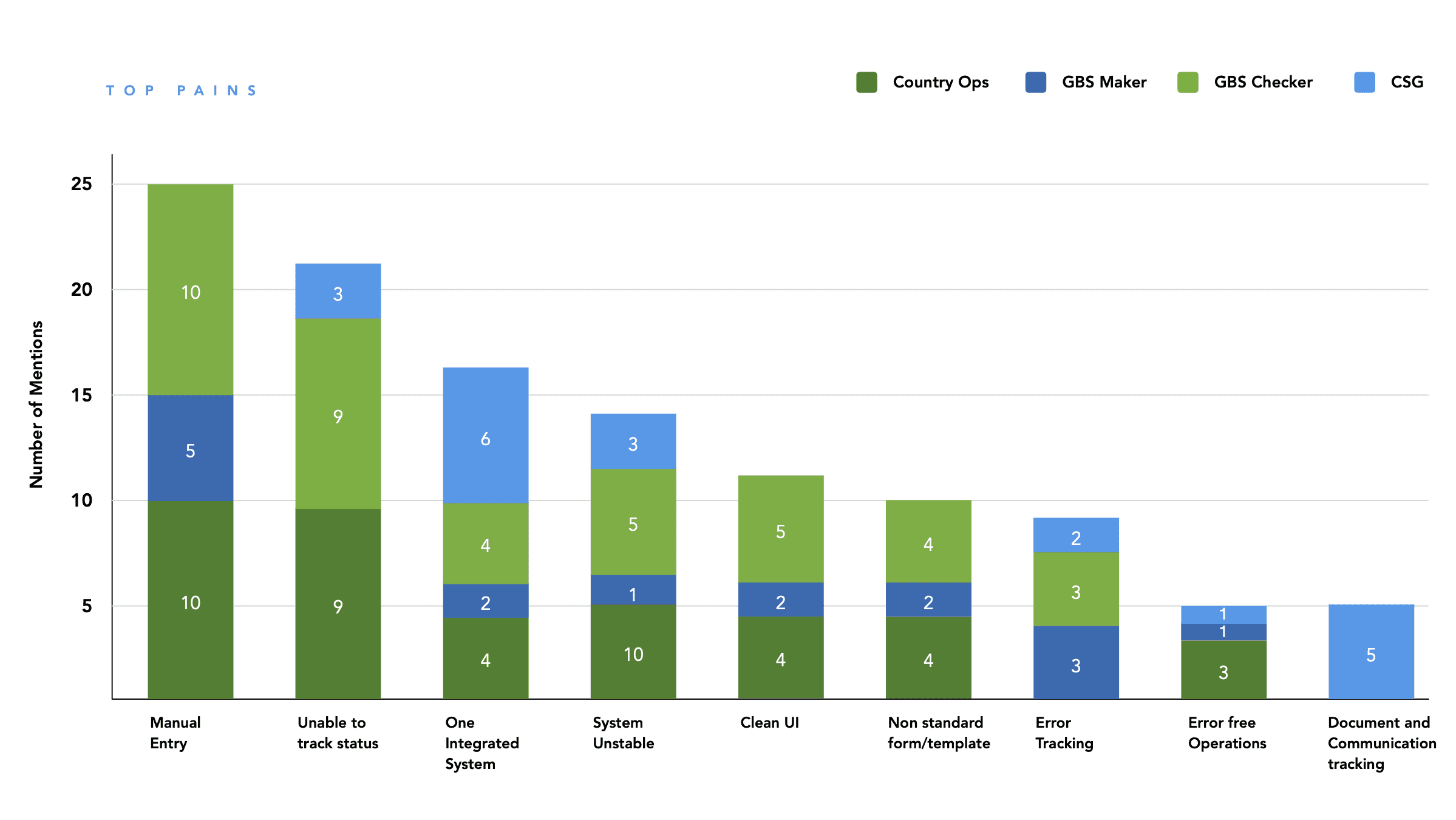
Pains

Value Proposition Mapping
Designing for Operational Clarity and Efficiency
Research showed that users did not need another standalone tool—they needed a connected operational ecosystem that reduced friction across the transaction lifecycle. Our designs needed to be informative, simple, and humanised to help users obtain required information for decision-making and adapt quickly to a new processing platform.
With this in mind, we focused on three strategic design directions:
1. Create a single operational view
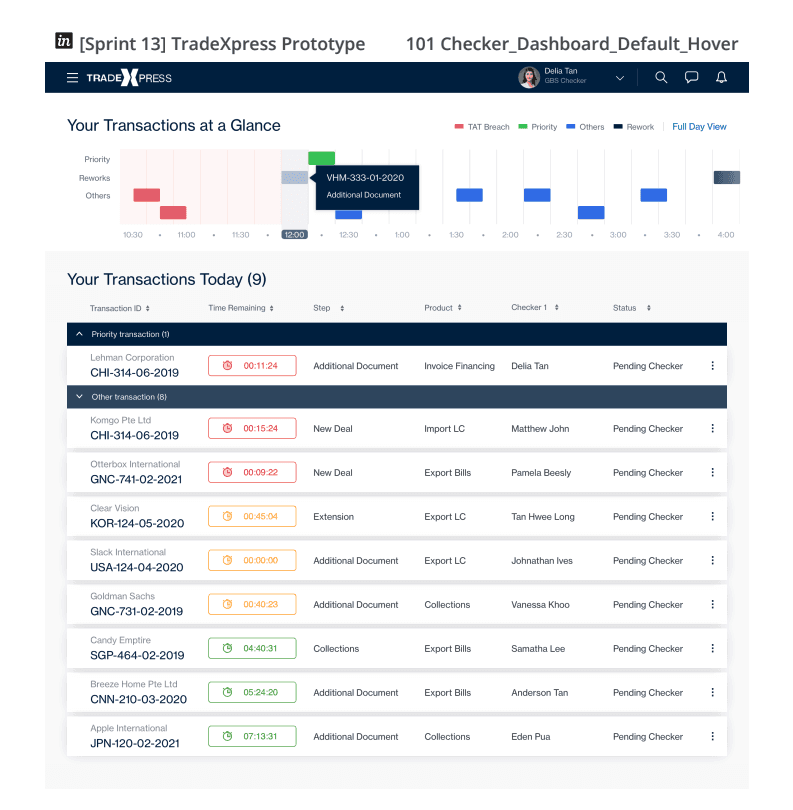
We designed a single, collaborative platform that consolidated client information, transaction details, communication history, and supporting documents into unified workflows. Dashboards had a comprehensive view of the deadlines for transactions, aiding users in workload prioritisation.
→ This removed the need for users to switch between systems and improved their ability to understand the status and context of new, ongoing, and historical transactions.
2. Surface the right information at the right time
We prioritised visibility of errors, transaction statuses, and compliance indicators to help users make decisions faster and with greater confidence. This was supported by an in-built communication feature and the ability to assign actions via the platform to speed up transaction processing.
→ Users mentioned being able to focus better on resolving issues and verifying transactions rather than searching for information across multiple sources.
3. Build for scale and flexibility
Alongside workflow improvements, we integrated a template-creation feature that allowed users to easily customise transaction details according to their client's needs. These templates could be saved and adjusted for future clients as well.
→ Users saw this as a key change to their process as it removed the need to repetitively find and input client details and document requirements across multiple clients, saving time and effort that could then be spent on processing other transactions.



Results and Impact
Delivered a research-driven vision for a more connected and efficient trade finance ecosystem.
Identified opportunities to reduce manual effort through workflow consolidation and automation.
Established a shared understanding of operational pain points across business, compliance, product, and technology teams.
Informed platform improvements that prioritised visibility, coordination, and decision-making across the transaction lifecycle.
Strengthened the design system through component audits and recommendations that improved consistency, scalability, and usability across future platform enhancements.
Reflections
By mapping journeys across multiple functions, I learned the importance of looking beyond individual pain points to understand how information, decisions, and responsibilities flow through an entire ecosystem. The ability to connect these perspectives was critical in uncovering opportunities that would have otherwise remained hidden within siloed teams.
The engagement also strengthened my ability to bridge research and design—translating complex operational realities into actionable flows and design direction that enabled the team to move quickly while remaining grounded in user needs.
